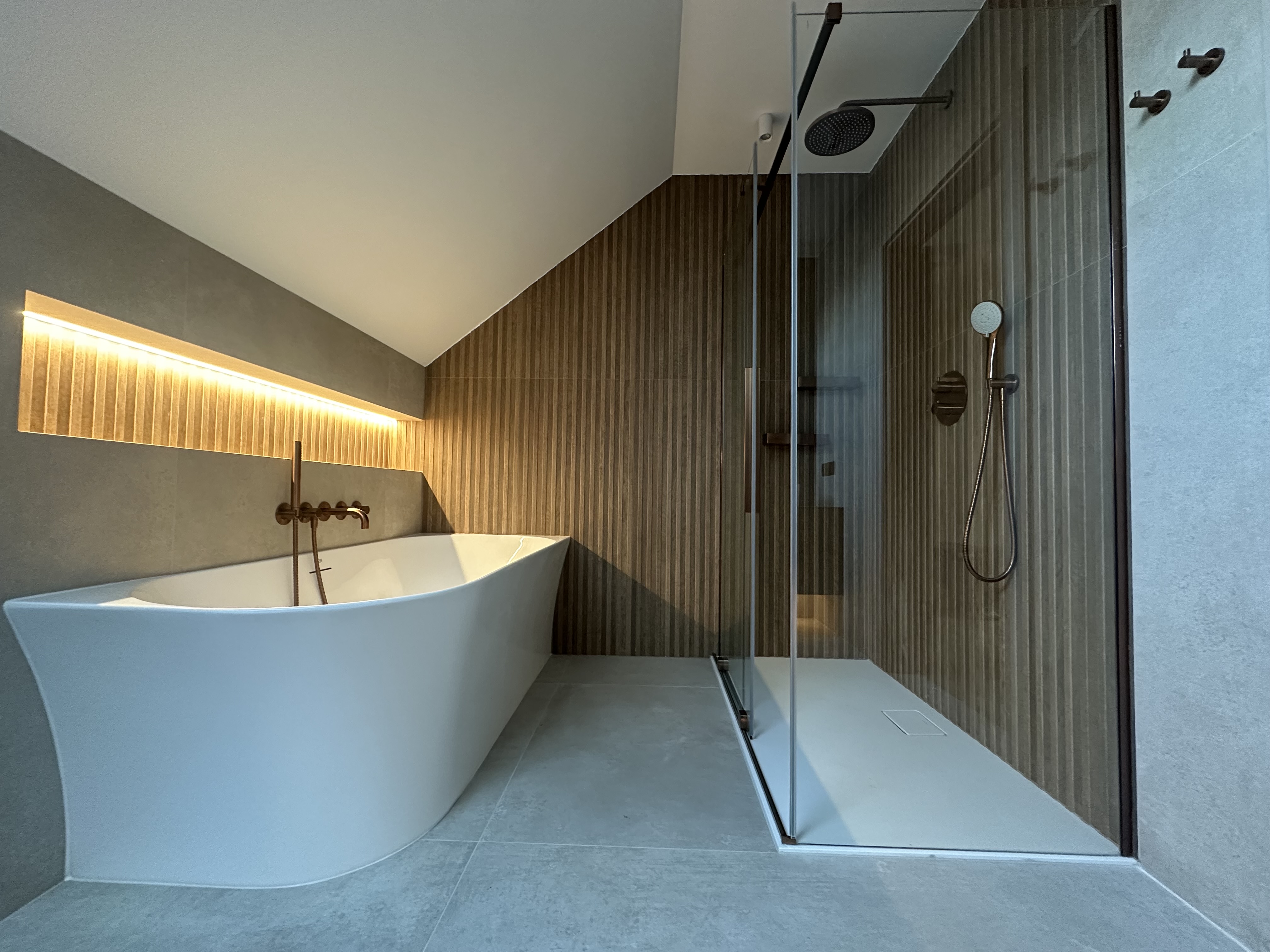
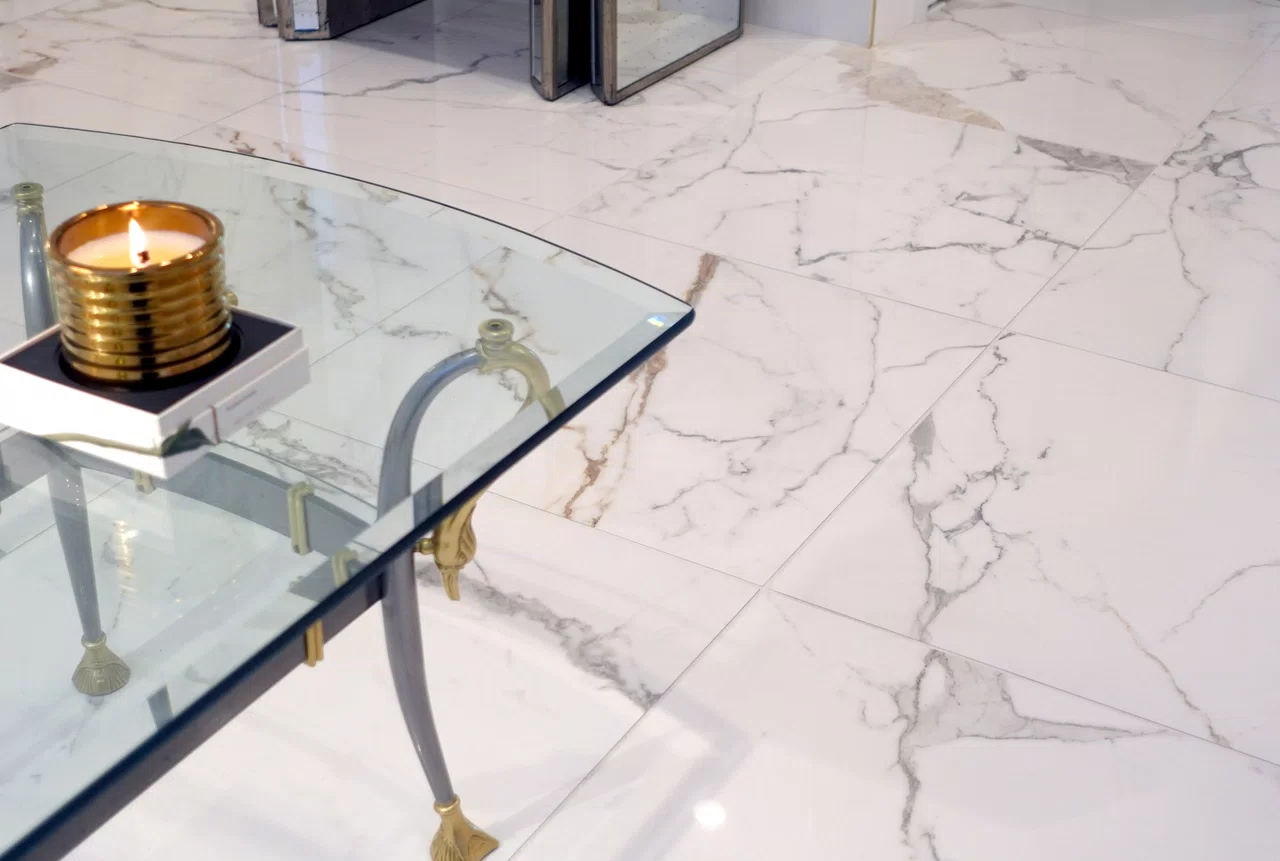
The 120×280 format is not just aesthetics — it brings completely different technical requirements than standard tiles. Adhesive, substrate, levelling, joints, cutting — every stage has its pitfalls. Here is how we do it at LOFTBAU.
The 120×280 format — what changes compared with a standard tile
A 120×280 tile covers over 3 m² and weighs — depending on thickness — between 18 and 30 kg. Every substrate deflection, every invisible ridge and every variation in adhesive thickness across such a surface translates into a visible result — an open joint, a crack, or an uneven light reflection. That is why working with this format starts with the substrate, not with the tile itself.
Substrates under formats above 60×60 cm must comply with EN 13813 — deflection no greater than L/300, residual moisture of a cement screed below 2% CM, anhydrite below 0.5%. In practice this means every screed must be tested with a CM moisture meter before tiling begins — measured, not estimated.
C2TE S2 adhesive — why there is no alternative
For 120×280 formats we use only adhesives meeting class C2TE S2 per EN 12004. C2 denotes improved adhesion (≥1.0 N/mm²), T — no slump on vertical surfaces, E — extended open time (≥30 min), S2 — deformability ≥5 mm. That last parameter is critical: with such large formats even minimal substrate movement generates stresses that a non-deformable adhesive simply transmits directly to the ceramic.
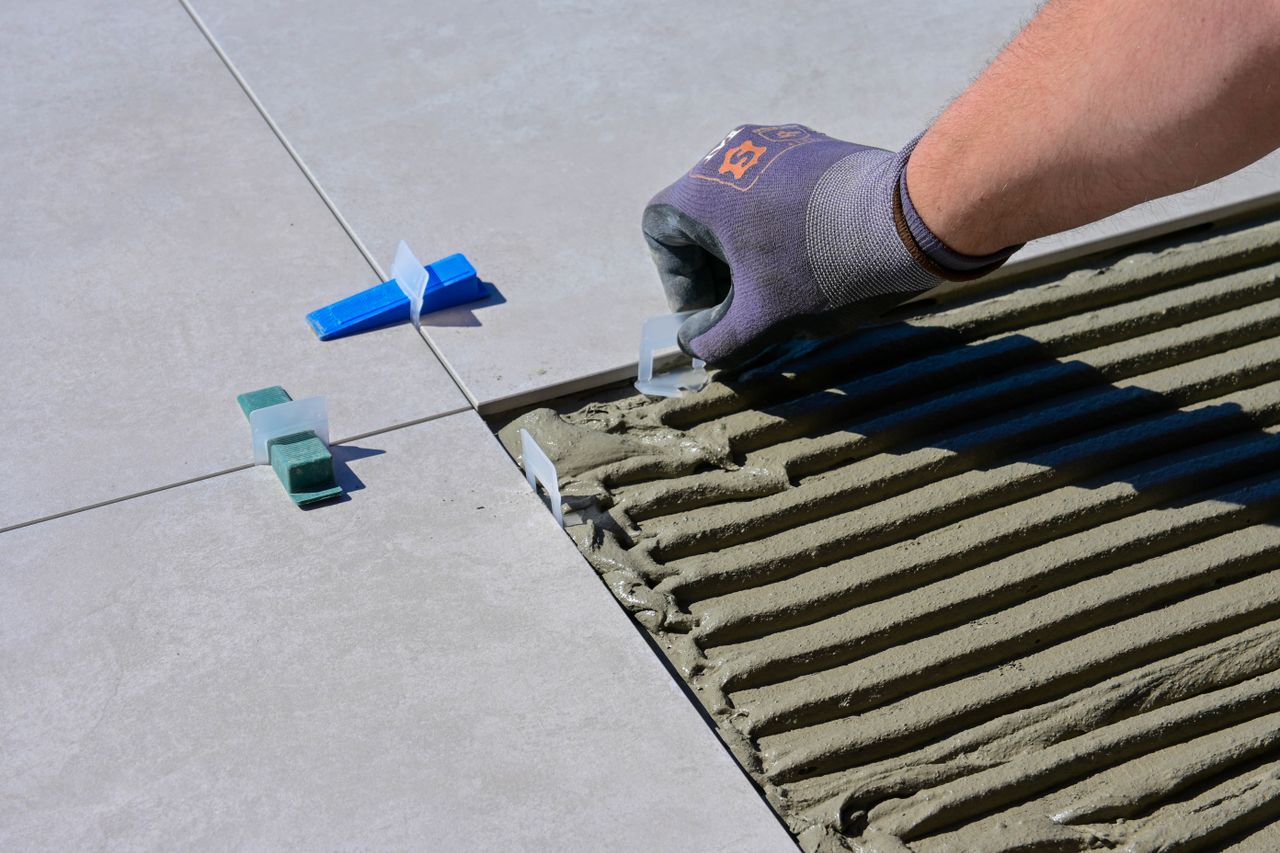
At LOFTBAU we use Mapei Ultraflex 2 and Kerakoll H40 Evolution — both meet C2TE S2 and are certified for large-format slabs including sintered stone. Adhesive is applied using the full-bed method on both surfaces (substrate and tile back) with a 10–12 mm notched trowel, combed at an angle to eliminate air pockets. Verification: when a laid tile is lifted, adhesive must cover at least 95% of the surface.
DLS and RUBI levelling systems — without them it makes no sense
Manual levelling of 120×280 tiles is practically impossible — the geometric tolerances of these formats and the adhesive open time offer no chance of levelling without assistance. We use the DLS (Dynamic Levelling System) or RUBI Tile Level Quick, depending on substrate and format.
The principle is straightforward: a levelling clip is inserted into the joint at each tile corner; a wedge driven in by a setting tool presses adjacent tiles into a single plane while the adhesive sets. After curing, the clip is snapped at the joint line and removed. The result: elimination of tile-to-tile height differences down to 0.1 mm — unachievable by hand at this format.
Premium bathroom pricing — Kraków
Labour from PLN 12,500 net · Free consultation
Minimum 1.5 mm joints — why the manufacturer requires it
For large formats, the required joint width is a minimum of 1.5–3 mm depending on the tile manufacturer. This is not an aesthetic requirement — it is a technical one. The joint acts as a micro-format expansion joint: it absorbs thermal and moisture stresses between adjacent tiles.
Reducing the joint below 1.5 mm (or eliminating it entirely, which was briefly trendy) leads to edge chipping and corner cracks under temperature and humidity changes. With underfloor heating this rule is even stricter — the minimum joint for formats ≥60×60 cm with heating is 3 mm, regardless of any aesthetic instructions from the architect.
Cutting and waste — how to calculate and plan
A 120×280 tile has a high unit cost — a cutting error means losing material worth €50–150. That is why every project with this format is preceded by a precise layout design accounting for room dimensions, the location of fixed points (drains, thresholds, channels) and the laying direction.
We use only wet-cut machinery with a diamond blade of at least 300 mm diameter — for formats over 160 cm long, a saw with a guide rail of at least 200 cm is essential. Diagonal cuts, cut-outs for fixtures and corner formatting are all done wet, with the full slab supported. Waste at a correctly planned 120×280 layout should be 8–15% — anything above 20% is a planning error.
Large-format tiles on walls — different challenges from the floor
On a wall, the 120×280 format requires an adhesive with the T parameter (no slump) and the time-consuming support of every tile while the adhesive sets. The wall must be perfectly plumb — tolerance is 2 mm per 2 m straightedge. Every verticality defect increases adhesive thickness under one edge of the tile and reduces it under the other, which over 280 cm translates into visible wedging.
For projects with 120×280 on a wall we use a two-stage application: adhesive on the wall first, then — after partial initial set — adhesive on the tile back. This technique, known as back-buttering, eliminates the risk of air pockets over such a large bond area and ensures the full adhesion required by the standard.