A cracked tile, an opening grout joint, debonding cladding – in most cases the cause is not a material defect but the absence of a buffer layer between the substrate and the ceramic. When is a decoupling mat essential, when is it recommended, and how do Mapei and Sopro systems work?
What is a decoupling mat and how does it work
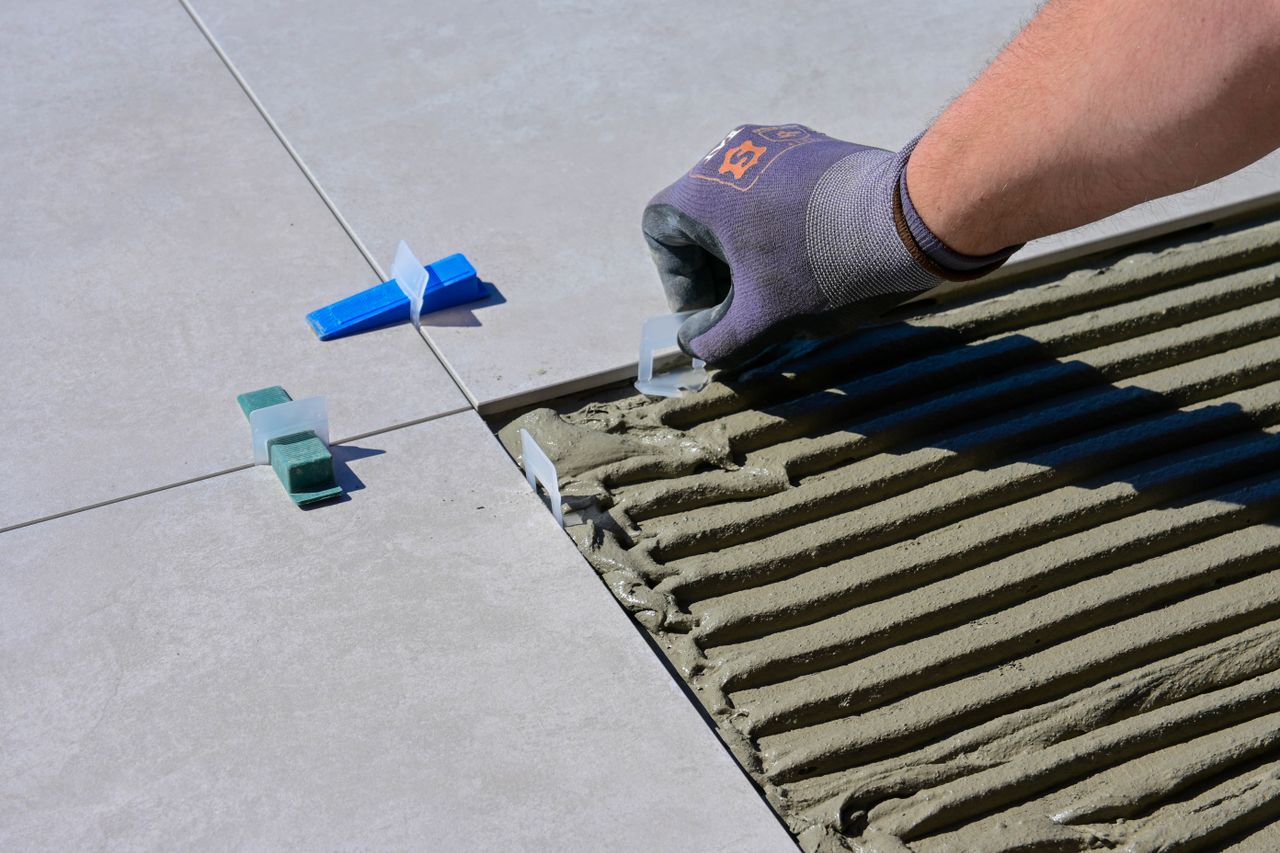
A decoupling mat is a thin material layer – typically a polyethylene sleeve film, a technical fleece mat or a foam-core fabric – laid directly on the substrate before the adhesive and tiles are applied.
The operating principle is simple: substrate deformations (screed shrinkage, thermal expansion, structural deflection) are absorbed by the mat structure instead of being transmitted directly to the adhesive and ceramic. The cladding can move independently of the substrate – within the limits of the system used. With systems such as Mapei UM 35 or Sopro mats, decoupling occurs through a layer that simultaneously allows adhesive keying on both sides – the result is cladding that technically 'floats' above the substrate while remaining firmly bonded.
New builds and fresh screeds – the risk you cannot see
A fresh cement screed is one of the most challenging substrates for ceramic cladding. During the first weeks and months after pouring, the screed loses moisture – it shrinks and moves. Screed shrinkage can range from 0.5 to 2 mm per metre – enough to cause grout joints to open or tiles to crack within the first season, without a decoupling mat.
In new residential developments where screeds are often completed just a few weeks before handover, the use of decoupling systems is particularly well-founded. Tile adhesive manufacturers specify minimum screed curing times in their technical data sheets – in construction practice these intervals are routinely shortened due to programme pressures. A decoupling mat is one of the realistic ways to reduce that risk.
Premium bathroom pricing — Kraków
Labour from PLN 12,500 net · Free consultation
Anhydrite screeds – characteristics that demand caution
Anhydrite (self-levelling) screeds have different properties from cement screeds – less shrinkage, but also lower resistance to point loads and moisture. They are soft, scratch-prone and do not tolerate direct water contact without appropriate priming.
In wet zones and with underfloor heating, a decoupling mat over anhydrite is technically justified – it creates a buffer layer between the sensitive screed and the ceramic and reduces the risk of substrate damage under service movement.
Underfloor heating – the strongest argument for decoupling
With underfloor heating, the ceramic cladding heats and cools cyclically. The thermal expansion coefficient of porcelain tile is approximately 6–8 × 10⁻⁶/°C; that of a cement screed is up to 12 × 10⁻⁶/°C. Over a 10 m² floor with a 20°C temperature swing, the difference in expansion between the two materials generates stresses that will gradually destroy grout joints without a decoupling mat and proper perimeter expansion joints.
The problem is compounded by hydronic heating systems operating in seasonal cycles. Large-format cladding laid directly on a heated screed without decoupling and expansion joints is one of the most reliable recipes for a fault after 2–3 heating seasons. Schlüter DITRA-HEAT integrates decoupling with an electric heating cable in a single system – particularly relevant where thermal expansion differences between materials are greatest.
Timber floors and framed structures
Timber floors and beam structures are substrates prone to deflection and vibration – two factors that ceramic cladding tolerates very poorly without decoupling. In older tenement buildings where floors are laid on boards or OSB panels, a decoupling mat is an essential element, not an optional one.
On timber substrates we use mats with enhanced deflection compensation capability – Mapei systems with deformable S1/S2 adhesives or dedicated Sopro mats for unstable substrates. Renovations in Kraków's tenement buildings and older housing stock are a scenario we encounter on a regular basis.
Renovations – laying new cladding over existing ceramic
Tiling over existing ceramic shortens renovation time and eliminates the need to chip out. However, old ceramic is a non-uniform substrate: different adhesives under individual tiles, variable bond strength, possible voids and micro-cracks.
A decoupling mat laid over old ceramic creates a uniform, predictable surface for the new cladding and interrupts any micro-movement between the old tiles that would otherwise be transmitted to the new layer. This is the solution used in refurbishments where removal is technically impossible or disproportionately expensive.
When essential, when recommended – a practical breakdown
Essential application (no mat = high risk of fault): electric or hydronic underfloor heating under large-format ceramic; timber floors and OSB panels; anhydrite screeds in wet zones; large formats (120×120 cm and larger) on screeds under 28 days of curing; sintered stone and natural stone with variable temperature.
Recommended application (significant risk reduction): cement screeds under 4 weeks of curing; tiling over existing ceramic; buildings with structural deformations; premium bathrooms with sensitive materials (travertine, marble, Laminam); wet zones on upper floors where any leak is a serious fault. Optional: new builds with fully cured cement screeds, no underfloor heating, formats up to 60×60 cm.
Systems used by LOFTBAU – Mapei and Sopro
At LOFTBAU we work primarily with Mapei and Sopro systems – manufacturers offering complete, certified solutions from mat, through deformable adhesive, to grout and waterproofing. Mapei UM 35 is a polyethylene sleeve film used for decoupling ceramic cladding on cement and anhydrite screeds, systemically compatible with Mapelastic Smart and Ultraflex 2 or Granirapid adhesives. Mapei Mapetex is designed for demanding unstable and timber substrates.
Sopro DS 193 is a highly deformable mat, systemically paired with Sopro FDS 523 waterproofing and dedicated to difficult substrates, anhydrite and large formats with hydronic underfloor heating. For specific technical requirements we draw on Schlüter (DITRA, DITRA-HEAT), PCI, Uzin and Botament systems – always as a complete single-manufacturer assembly, never a mixture of products from different brands.
Decoupling mats and expansion joints – two elements of one system
A decoupling mat does not replace expansion joints – they are two different protection mechanisms acting in a complementary way. The mat absorbs substrate micro-movement perpendicular to the cladding plane. Perimeter and field expansion joints allow the ceramic to expand freely in the horizontal direction.
In every project with a decoupling mat we install: a perimeter expansion joint (gap of approx. 6–8 mm along all walls, filled with Mapei Mapesil AC silicone or polyurethane sealant), field expansion joints every 4–6 m in open areas, and expansion joints at underfloor heating zones every 3–4 m or as specified by the heating system manufacturer. Omitting expansion joints when a mat has been installed is one of the most common errors – the system only works when both elements are correctly executed.