Underfloor heating combined with large-format ceramic is a pairing that, when executed incorrectly, produces defects after just one heating season. Cracked joints, debonding tiles, raised corners — here are six mistakes we see repeatedly in repair jobs.
Mistake 1 — Adhesive that cannot handle the temperature
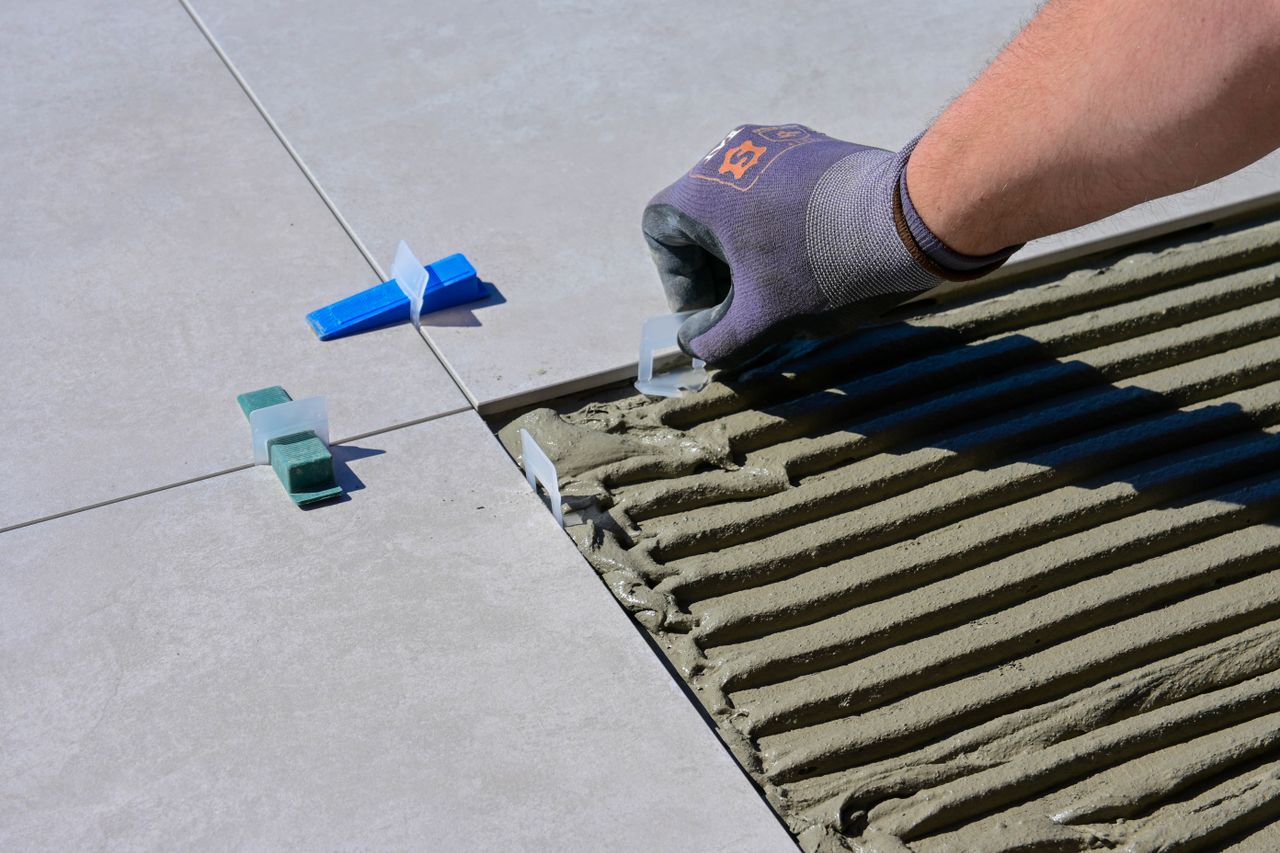
A standard cement adhesive of class C1 or C2 without a deformability parameter (S1/S2) operates in a cyclically heated and cooled environment with underfloor heating. Every heating cycle generates thermal stresses between the ceramic and the screed — without deformability these stresses are not absorbed but accumulate at the adhesive–ceramic interface.
The effect is typically visible after the first or second heating season: a hollow sound when tapping the tiles, opening joints at corners, and with aggressive heating — debonding corner pieces. The solution is straightforward: adhesive of at least C2TE S1 for electric heating, S2 for hydronic and for large formats. Mapei Ultraflex 2 and Kerakoll H40 are our standard choices in both cases.
Mistake 2 — No perimeter expansion joint or too narrow a gap
Ceramic expands linearly with temperature rise — the thermal expansion coefficient of porcelain is approximately 6–8 × 10⁻⁶/°C. In a room of 5×4 m with a floor temperature rise of 20°C the ceramic expands by nearly 1 mm per metre. Without a perimeter expansion joint the ceramic has nowhere to go — it pushes against the wall, leading to debonding or cracking of the tiles at the edge.
A correct perimeter expansion joint is a gap of 6–10 mm along all walls, filled with flexible silicone (not grout) with a Shore A hardness below 25. With underfloor heating we always install a silicone expansion strip before pouring the screed — it guarantees a uniform and controlled gap around the entire perimeter. Field expansion joints every 4–5 m with hydronic heating — a standard, not an option.
Mistake 3 — Tiling on a fresh screed without full curing
A cement screed needs a minimum of 28 days of curing under normal conditions (15–25°C, 50–65% relative humidity) before ceramic can be laid. An anhydrite screed — a minimum of 7–14 days, but only with adequate ventilation. For underfloor heating, the screed additionally requires a drying programme (gradual heating and cooling) before tiling, in accordance with the heating system manufacturer's protocol.
In construction practice these timescales are routinely shortened. The effect: the screed under the ceramic continues to shrink and move, and the adhesive and joints cannot keep up. A decoupling mat reduces that risk but does not eliminate it — it never replaces proper curing. Before we begin tiling we always measure screed moisture with a CM moisture meter.
Premium bathroom pricing — Kraków
Labour from PLN 12,500 net · Free consultation
Mistake 4 — Air-sensing thermostat instead of a floor sensor
An underfloor heating thermostat with an air sensor controls the air temperature in the room — which sounds logical but is a poor solution for ceramic. With a low outdoor temperature and a cold window, the thermostat may heat the floor to very high temperatures in an attempt to raise the air to the set point.
The surface temperature of bathroom ceramic with underfloor heating should not exceed 29°C. Above this limit, thermal stresses in the ceramic–adhesive–screed assembly rise sharply. The only safe solution is a thermostat with a floor sensor (or with both sensors and a floor temperature limiter). This is one of those details that the electrician forgets — and the tiler pays for.
Mistake 5 — Insufficient heating output and excessively long cycles
Insufficient output from the heating mat or inadequate pipe loop length in hydronic systems means the system must operate very long cycles to reach the set temperature. Long cycles mean slow heating and cooling — seemingly better for ceramic, but in practice they result in uneven temperature distribution across the surface (cold 'islands' between pipes).
Minimum recommended output for a bathroom is 100–150 W/m² for an electric mat and 70–80 W/m² for hydronic heating with pipe spacing of 10 cm. These values are specified by system manufacturers and must be verified by the installer before ceramic is laid — not after.
Mistake 6 — Activating heating too soon after tiling
After tiling, adhesive and grout require curing time at appropriate temperature. Activating heating before the curing time has elapsed (minimum 48h for adhesive, 24h for standard grout, 7 days for epoxy grout before first activation) destroys the chemical bonding structure — the adhesive will not achieve full strength before being subjected to thermal stresses.
The rule: first activation of underfloor heating after tiling — not before 7 days after the adhesive was laid (or 14 days with epoxy grouts). First activation progressively: +5°C per day, for a minimum of 5 days, before reaching target temperature. This protocol is specified by adhesive and heating system manufacturers — and is routinely ignored.