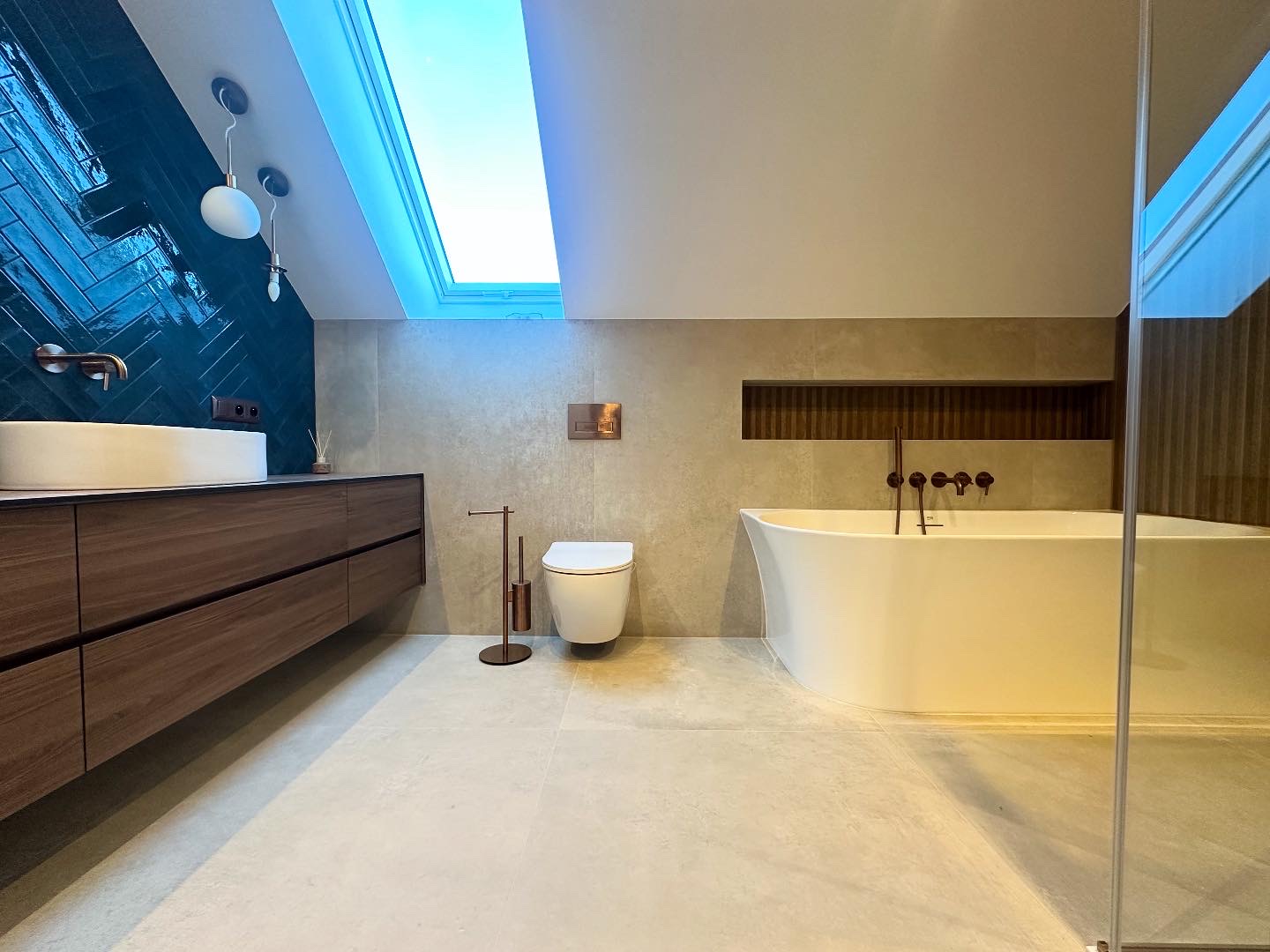
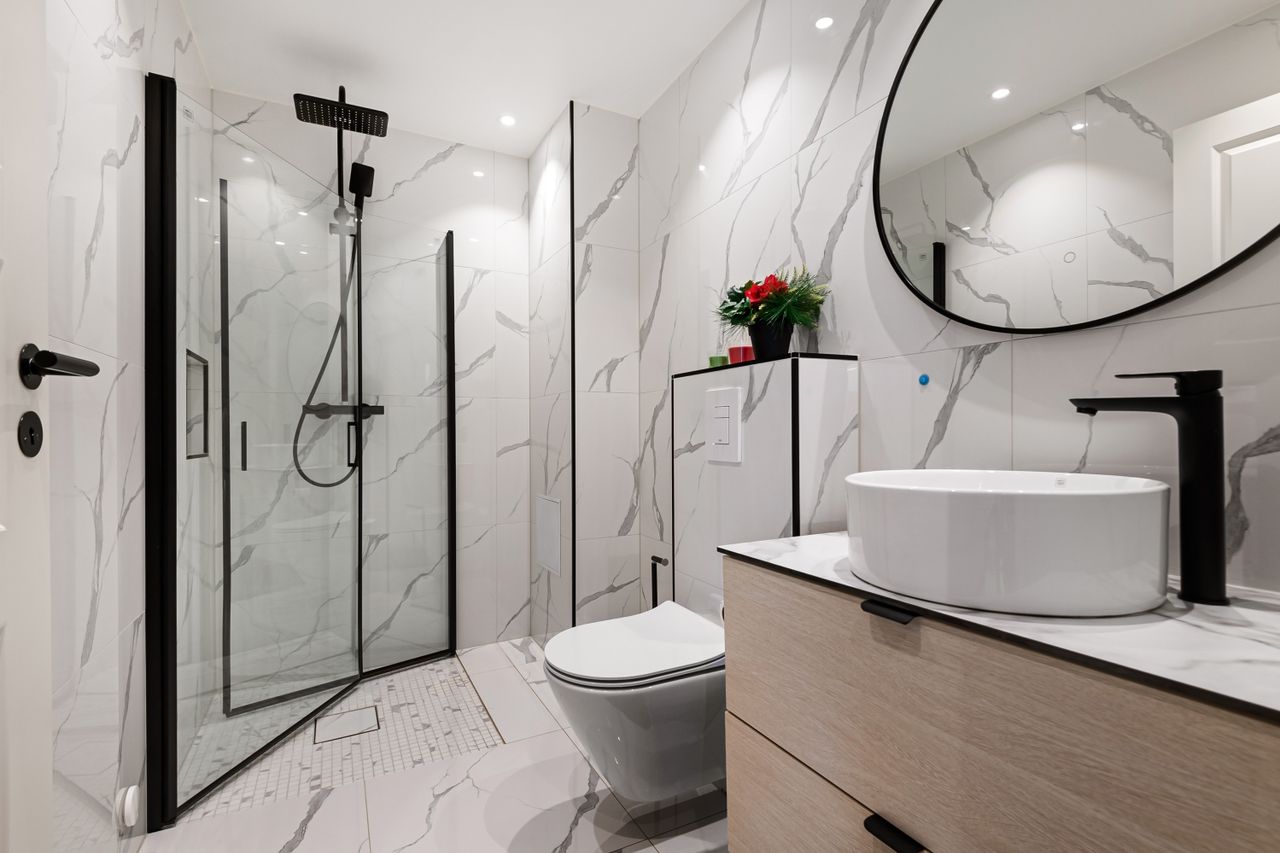
Four square metres is not a reason for compromise — it is a design challenge. Here are five rules that turn a small bathroom into a space reminiscent of a boutique hotel: no unnecessary fixtures, no low ceilings and no random materials.
Rule 1 — Linear drain instead of a shower tray
A shower tray in a small bathroom is one of the biggest visual mistakes — it takes up floor space, requires a perimeter seal and visually divides an already small area. A linear or point drain set flush with the floor eliminates this problem: the floor becomes one uninterrupted plane from the threshold to the wall.
A linear drain requires careful waterproofing and the correct floor slope (a minimum of 1–1.5% towards the drain). A walk-in enclosure without a tray and without shower doors is technically feasible from a shower zone width of 90 cm — with correct Mapelastic waterproofing and well-designed ventilation. This is our recommendation for a premium bathroom under 5 m².
Rule 2 — Large-format tile laid vertically = a taller wall than it is
A 60×120 or 60×180 tile laid vertically (long edge upwards) visually elongates the wall and ceiling. The effect is particularly strong when the same tile runs from floor to ceiling with no break in décor or border strips. Consistency of material between floor and wall (matching or coordinated colour and texture) reduces the number of visual boundaries and makes the small space feel more generous.
In designs where one material covers all surfaces (floor, walls, sometimes ceiling), careful joint alignment is critical — a cross or brick-bond pattern must be planned in advance, not adjusted on site. In a 4 m² bathroom the difference between 'roughly aligned' and 'planned to the millimetre' is immediately visible.
Rule 3 — Floor-to-ceiling mirror without a frame
A framed mirror in a small bathroom is another boundary the eye interprets as a reduction in space. A full-height mirror from worktop to ceiling, without a frame or with an invisible clip mount, continues the wall plane and almost doubles the optical depth of the room.
With a frameless mirror the precise seating of the edge is critical — the glass must end exactly on a grout line or the edge of the wall material. This requires coordinated planning with the tile layout, not an afterthought. LED lighting built in below or above the mirror eliminates facial shadows and adds depth — particularly effective with dark wall materials.
Premium bathroom pricing — Kraków
Labour from PLN 12,500 net · Free consultation
Rule 4 — Recessed wall niche instead of a shelf or cabinet
A built-in niche in the shower wall or beside the basin is one of those details that distinguishes a 'finished' design from a 'standard' one. The niche does not protrude from the wall plane, casts no shadow, collects no dust on top and does not visually compete with the wall material — it is part of it.
A niche requires planning at the wall-building stage or before concrete is poured — it cannot be added after tiles are laid. Standard dimensions: 30×90 cm or 20×60 cm, depth 10–12 cm (half the partition wall thickness). Finished in the same material as the wall, or in a contrasting accent (mosaic or stone) — both look excellent when designed rather than incidental.
Rule 5 — One colour palette, three materials maximum
A small bathroom with many colours and materials looks cluttered regardless of the care taken in execution. The rule we apply in our premium projects: one dominant colour (beige, grey, anthracite, white), one metallic accent (gold, brass, matt black) and a maximum of three different visible materials.
An example scheme for 4 m²: large-format porcelain imitating Biancone marble on floor and wall (one material), fixtures and linear drain in matt black (one accent), wood or wood-effect veneer only on the vanity unit (one contrast). Everything else — towels, glass bottle, a single plant — is décor that can be changed. The structure remains calm and clean.
Ventilation and lighting — the invisible foundations
Even the most beautiful small bathroom design will be ruined by moisture and mould. In a room under 5 m² without a window, mechanical ventilation is mandatory — and not just any fan, but one with a real output of at least 60 m³/h (not a miniature 20 m³/h unit that merely satisfies the formal requirement). A fan with a hygrostat that starts automatically above 65% relative humidity is standard in our premium projects.
Lighting in a small bathroom serves not only a functional purpose but a spatial one. Recessed downlights create shadows that visually lower the ceiling. A better solution is perimeter lighting (LED strip behind frosted glass around the ceiling or behind the mirror) that evenly illuminates the walls and eliminates the shadow at the ceiling.