A durable sintered-stone installation depends on the substrate, full slab support, the right adhesive and precise processing. This guide covers the key execution decisions through to grouting.
What must be established before installation?
Sintered stone and porcelain stoneware belong to the same family of ceramics fired at high temperature. They differ in composition, production method and available formats, but from an investor's perspective what matters most are their performance properties.
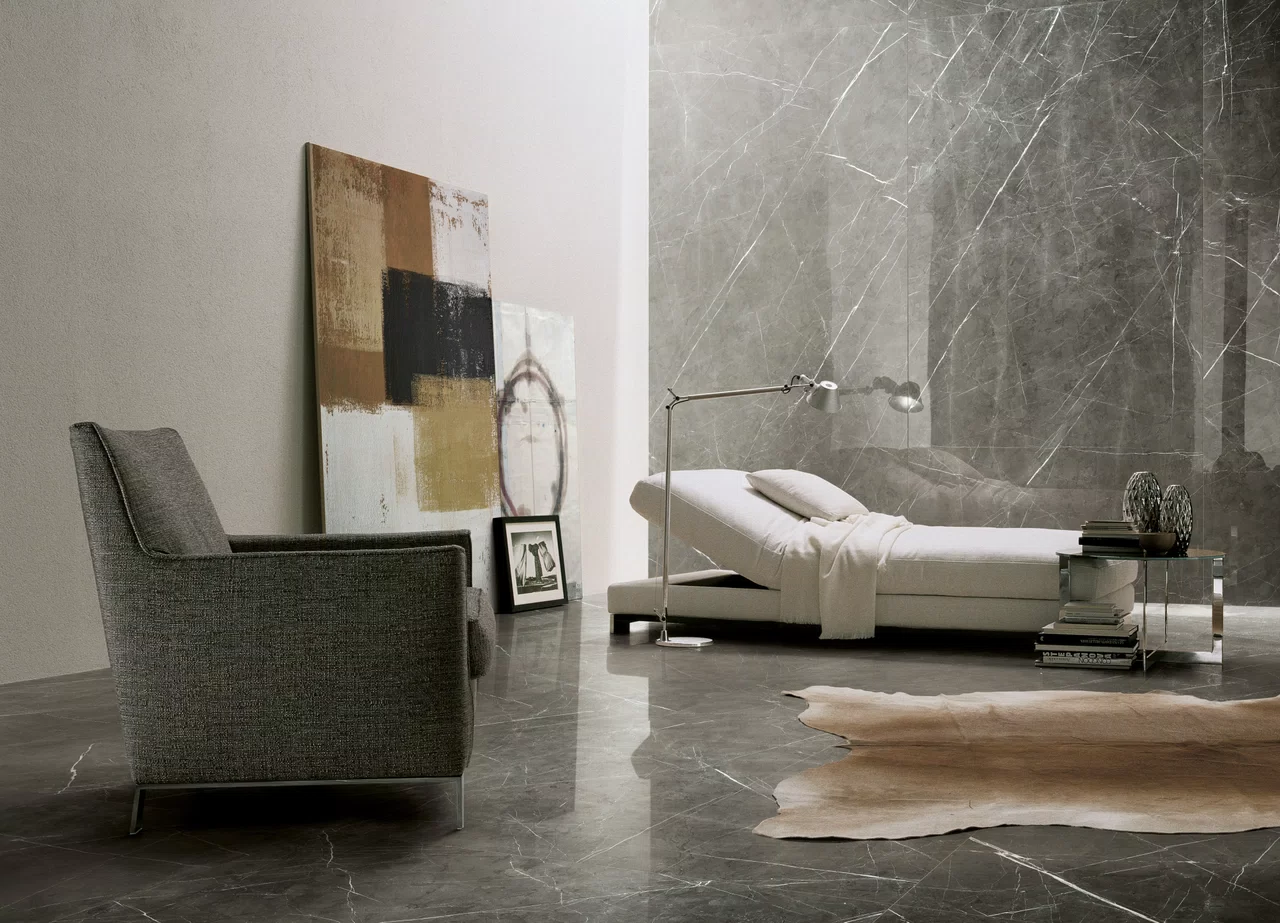
The main advantages of sintered stone are very large slab formats, low water absorption and high resistance to temperature. This means the material can be used not only on walls and floors but also on worktops, furniture fronts and other interior elements.
When choosing sintered stone, slab thickness, workmanship quality and the experience of the installation team matter more than the manufacturer's name.
Slab thickness and installation method
Sintered stone is available in a range of thicknesses — from a few to over ten millimetres.
Thinner slabs are most commonly used on walls, furniture fronts and renovations where new cladding is installed over an existing surface. Many manufacturers also allow slabs of 5–6 mm on floors, provided the substrate is properly prepared and installation follows their guidelines.
Slabs of 10–12 mm are more often chosen for floors, worktops and areas subject to greater mechanical load. They provide higher rigidity and a greater safety margin in everyday use.
There is no single universal rule for every situation. The final choice should follow from the intended use and the conditions of the specific project.
Sintered stone and underfloor heating
Sintered stone works very well with underfloor heating. Thanks to its low thickness and good thermal conductivity, it transfers heat to the room quickly.
What matters most is correct substrate preparation, maintained expansion joints and the right installation materials. Problems that occur on such floors most often arise from installation errors or substrate defects, not from the sintered stone itself.
Premium bathroom pricing — Kraków
Labour from PLN 12,500 net · Free consultation
Full slab support is the foundation of durability
With large formats, full support across the entire slab surface is critical. In practice this means applying adhesive to both the substrate and the underside of the slab.
This eliminates voids beneath the material and ensures even load transfer. Leaving voids under a large format increases the risk of damage in use.
Thorough substrate preparation and correct adhesive spreading are therefore just as important as the choice of material.
Which adhesive to use for sintered stone?
For large formats, high-deformability adhesives designed for demanding ceramic cladding are used. Depending on the substrate type, slab size and service conditions, deformable adhesives of class S1 or S2 are specified.
In practice, with large formats, underfloor heating and demanding substrates, many installers choose S2 class adhesives because they offer greater stress transfer capacity and an additional safety margin.
Even the best adhesive cannot compensate for a poorly prepared substrate or installation errors. The durability of the cladding is determined by the entire system of execution — not by the brand or class of any single product.
Processing sintered stone requires experience
With large formats, the quality of the finished work is determined not only by the material but above all by how it is processed. This is the stage where the difference between average installation and high-quality execution is most visible.
The greatest precision is required for 45-degree corner mitres. Achieving a perfectly straight joint without chipping demands accurate edge scoring, multi-stage grinding and manual finishing of every detail. Equipment alone cannot deliver this result — it depends on the installer's experience, patience and skill.
The same applies to cutting openings for taps, flush buttons, linear drains, electrical sockets and built-in elements. Every opening must be executed with great accuracy, because even minor errors are visible after installation is complete.
The best installers treat sintered stone not as an ordinary tile but as a material requiring individual treatment. Every edge, every cut and every corner is checked and refined by hand before it is set.
This is precisely why two bathrooms made from identical material can look completely different. The final result depends not only on the quality of the sintered stone but above all on the precision of the execution.
In a well-executed bathroom, the client does not notice individual cuts or corners. They see only a coherent, beautiful whole. These apparently invisible details are what most often distinguish standard workmanship from the highest level of execution.
Does sintered stone require sealing?
In most cases, no.
Sintered stone has very low water absorption and does not have the open structure characteristic of many natural stones. It therefore does not require sealing in the way that marble, travertine or limestone do.
It is worth remembering, however, that not needing to seal the slab itself does not mean the surface requires no maintenance at all. Ease of cleaning depends on the type of grout, the quality of the installation and regular surface cleaning.
Epoxy grout or cement grout?
Epoxy grouts have very high resistance to moisture, staining and chemicals. They are therefore often used in shower enclosures and other zones in constant contact with water.
They are not the only correct solution, however. In many projects high-quality cement grouts with enhanced technical parameters perform excellently.
The choice of grout type should be tailored to the way the bathroom is used and the desired aesthetic result.
Pattern continuity requires early planning
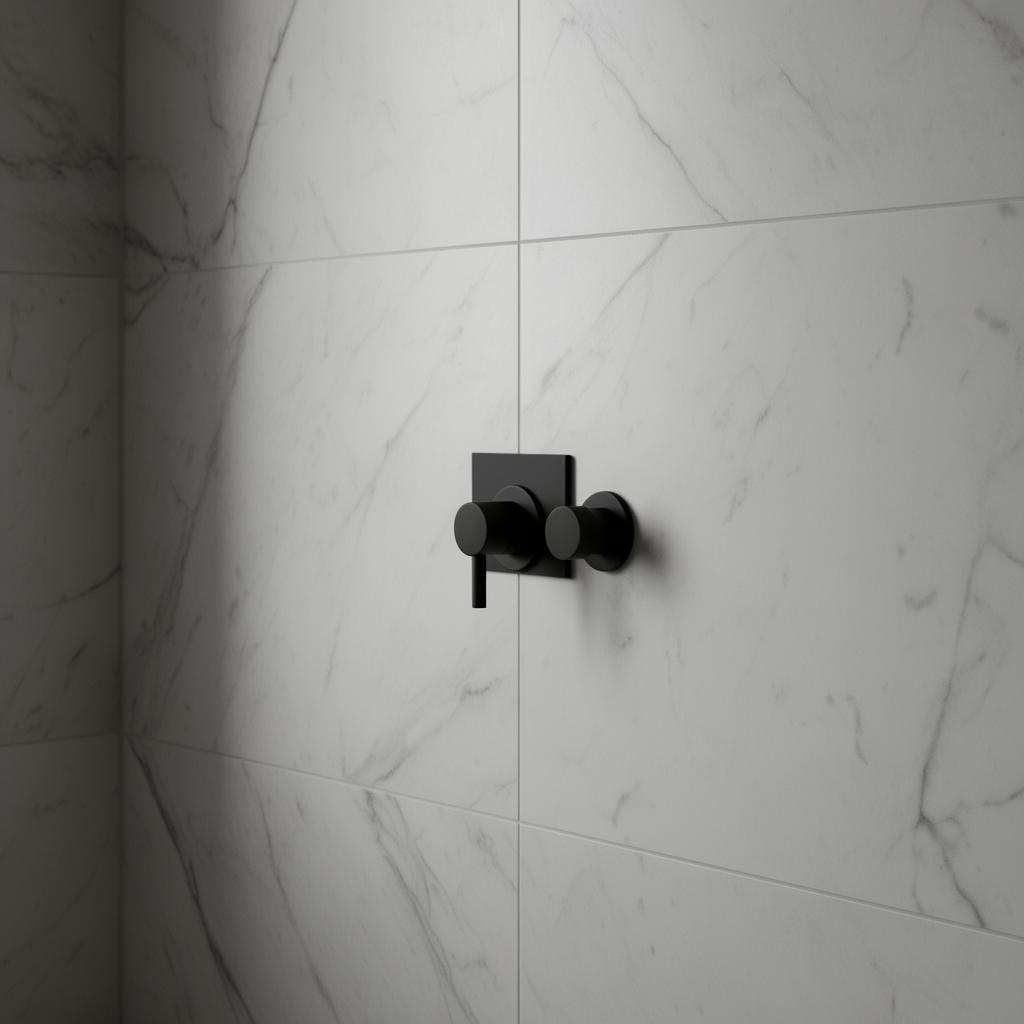
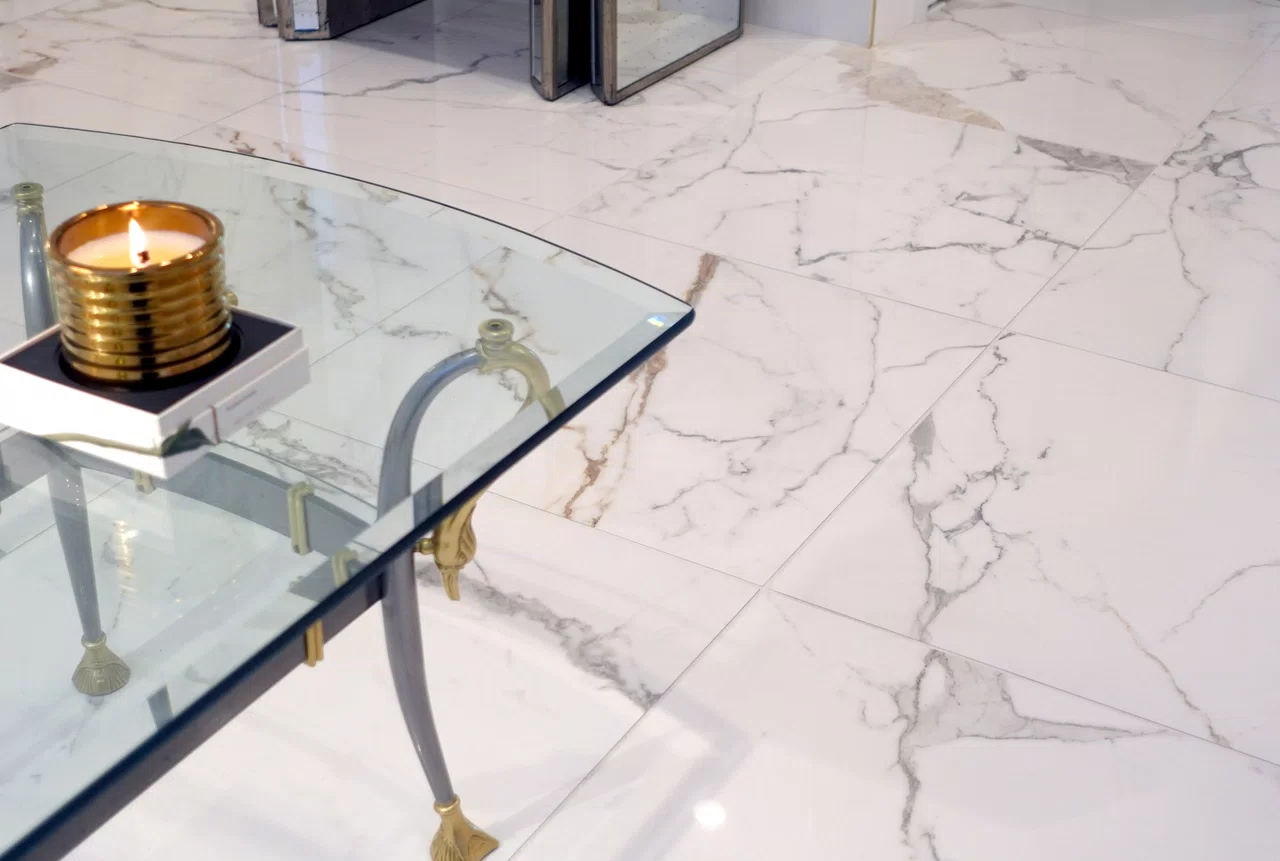
Large formats often imitate natural marble or stone. If the client wants to maintain vein continuity between adjacent walls or achieve a mirror-image pattern, the entire layout must be planned before cutting begins.
At this stage the placement of individual slabs, the run of the pattern and the way corners are handled are all determined. This ensures the finished result looks coherent and natural.
Errors made during planning are usually impossible to conceal after installation is complete, which is why this stage matters as much as the tiling work itself.
Summary
Sintered stone makes it possible to create modern bathrooms with minimal grout lines and large, unbroken surfaces. It is a durable material, resistant to moisture, that works well with underfloor heating.
The durability of the finished result is not determined solely by the material brand, however. The quality of the substrate, correct choice of installation materials, precise processing and the experience of the installer are all critical.
A well-executed sintered stone bathroom can retain both its aesthetic and functional qualities for many years. That is why, with large formats, it is worth paying attention not only to the material itself but also to the people who will be processing and installing it.